
Reviewed · WALKING TOURS
Edinburgh: Dean Village & New Town Walking Tour
Dean Village is the surprise at the heart of this walk. Just a short distance from Princes Street, it feels far removed from central Edinburgh, with old mill buildings, water-mill history, and stone plaques showing loaves and pies. I like that the tour then shifts from this medieval working village to the orderly Georgian New Town, giving you two very different sides of Edinburgh in one outing. I also like the focus on people such as David Hume, Adam Smith, and Arthur Conan Doyle, rather than architecture alone.
The main consideration is pace. You cover a lot in about two hours and fifteen minutes, with several brief stops of five to fifteen minutes. You will spend much of the time walking and listening outdoors, so poor weather can affect the experience. Guide Irene has led this route for some groups, and the tour is capped at 20 people, which should make it easier to hear than a large city walk.
Key points to know before booking
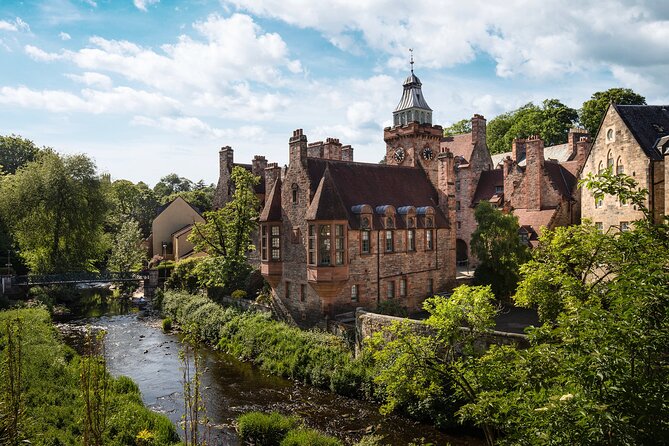
- Dean Village begins the tour: See a former medieval baking and milling center close to central Edinburgh.
- The New Town explains Edinburgh’s Georgian identity: Charlotte Square, George Street, and St. Andrews Square reveal the city’s planned, neoclassical side.
- History goes beyond pretty buildings: The route covers the Scottish Enlightenment, colonialism, high society, secret bars, and the working lives behind the grand streets.
- You get repeated castle views: Castle Street and Princes Street Gardens offer some of the clearest views of Edinburgh Castle and Castle Rock.
- The walk ends near Christmas markets and central transport links: Dundas House in St. Andrews Square is a useful finish for continuing your day.
- The price is modest for a guided city walk: At $27.37 per person, the value depends mainly on how much context and local orientation you want.
Why Dean Village is the right place to begin
The meeting point is at 2 to 4 Hope Street, near the western side of central Edinburgh. From there, the route heads toward Dean Village, a compact neighborhood beside the Water of Leith. The setting changes quickly, and that contrast is one of the best reasons to choose this tour.
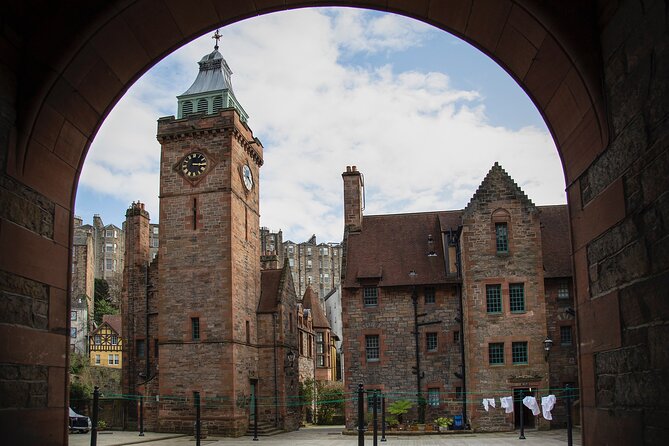
Dean Village dates back to medieval times and once supported bakers, weavers, and water mills. You will see reminders of that working past in mill stones and stone plaques decorated with bread and pies. This is not simply a photogenic lane added to a city sightseeing route. It shows how Edinburgh’s growth depended on small industrial communities as well as grand civic buildings.
I like this opening because it gives you a useful frame for the rest of the walk. The New Town can look polished and carefully planned, but Dean Village brings you closer to the practical labor that kept the city fed and supplied. The short visit lasts about 30 minutes, long enough to understand the place without turning the tour into a full neighborhood exploration.
You should also keep expectations sensible. The tour does not list an interior visit in Dean Village, and the admission is free. You are there for the streets, mill remains, plaques, and explanation from the guide. The route is especially useful if you have already seen the Royal Mile and want a quieter part of Edinburgh.
More Walking Tours in Edinburgh
- Underground Vaults Walking Tour in Edinburgh Old Town
★ 4.5 · 8,506 reviews - Edinburgh Castle: Guided Walking Tour with Entry Ticket
★ 5.0 · 5,540 reviews - Edinburgh Castle Guided Walking Tour in English
★ 5.0 · 5,214 reviews
Charlotte Square and the idea of the New Town
After Dean Village, the walk moves toward Charlotte Square and the New Town, a UNESCO World Heritage site. The shift is striking. Instead of narrow medieval streets, you find broad planned spaces, formal facades, and neoclassical design.
The stop at Charlotte Square lasts about ten minutes. That may sound brief, but the purpose is clear: your guide introduces the plan and style of the New Town, then connects it to Edinburgh’s reputation as the Athens of the North. The nickname reflects the city’s intellectual and architectural ambitions during the period of the Scottish Enlightenment.
This is where the tour’s subject becomes larger than buildings. You learn how thinkers such as David Hume and Adam Smith fit into Edinburgh’s intellectual life. The route also includes streets associated with inventors, scientists, and writers, including Arthur Conan Doyle. You are not just looking at handsome stonework. You are being shown how the city’s ideas and public image grew together.
For you, the value depends on how much context you want from a walking tour. If you only want photographs, Charlotte Square is easy to see on your own. If you want to understand why the New Town was built and what it represented, a guide adds much more.
The Georgian House and life behind the facade
At Charlotte Square, the tour pauses outside the Georgian House, a major mansion connected with the National Trust for Scotland. The stop lasts around ten minutes and focuses on what high society life was like in eighteenth and nineteenth-century Edinburgh.
The attraction here is the social story. A grand facade can tell you about money and taste, but it does not automatically explain how people used the rooms, how social rank shaped daily life, or how the New Town was meant to function. The guide helps turn architecture into a picture of urban life.
The itinerary specifies a stop outside the Georgian House, not a scheduled admission inside. That matters if you are hoping to tour the rooms. You should treat this part as an exterior explanation rather than a house visit. If the interior interests you, you may want to plan a separate visit at another time.
I appreciate that the tour includes both the elegant and uncomfortable sides of the New Town. The discussion of colonialism and its effect on Edinburgh’s growth gives the grand buildings a more honest setting. You can admire the design while also asking who benefited from the wealth that helped shape the city.
Rose Street and the story of secret bars
From Charlotte Square, the route enters the New Town grid and reaches Rose Street. Today, Rose Street is known for pubs, but the guide uses it to explain why secret bars were established in the New Town.
This is a good example of the tour’s approach. Rather than stopping only at famous monuments, it uses an ordinary street to tell a social story. A pub-lined lane becomes a clue to Edinburgh’s past and to the rules, habits, and hidden corners of Georgian society.
The stop is about ten minutes. You will not spend the evening sampling bars, and food or drinks are not listed as part of the experience. The benefit is the explanation, plus the chance to note places you may want to return to later. One useful touch from the tour is that guides can offer restaurant suggestions, so Rose Street may help you plan a meal after the walk.
Other walks around Edinburgh:
- Edinburgh Darkside Walking Tour: Mysteries, Murder and Legends
★ 5.0 · 3,862 reviews - Haunted Vaults Walking Tour in Edinburgh
★ 5.0 · 2,183 reviews - Old Town Walking Tour History and Tales in Edinburgh
★ 5.0 · 2,168 reviews - The Mountebank Comedy Walk of Edinburgh
★ 5.0 · 1,813 reviews
Castle Street and Princes Street Gardens
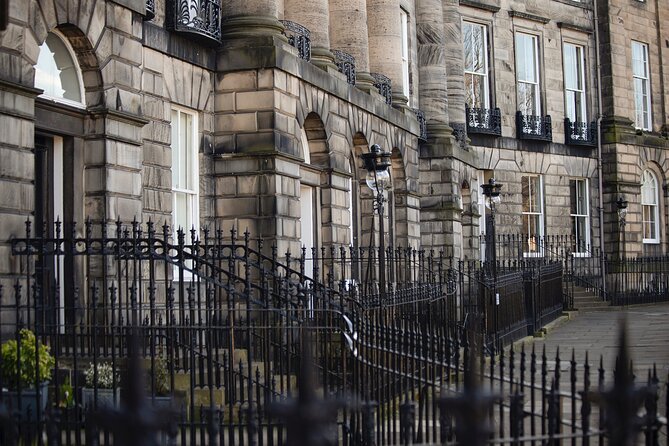
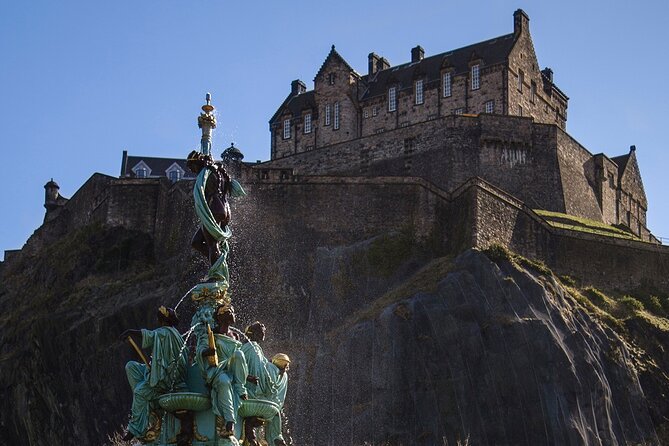
Castle Street provides one of the tour’s best visual pauses. From here, you get a clear view toward Edinburgh Castle and Castle Rock. This is a helpful moment because the New Town’s regular streets can sometimes feel more formal than dramatic. The castle brings the city’s volcanic setting and older past back into view.
The next stop is Princes Street Gardens, where the group spends about 15 minutes. The gardens offer another castle view, along with examples of public art. Crossing Princes Street also helps you understand Edinburgh’s layout. The New Town sits directly beside one of the city’s main public spaces, with the Old Town and castle rising nearby.
You will want to keep your phone or camera ready here, but the guide’s comments are the real point. The gardens are easy to visit without paying an entrance fee, so the tour’s value comes from tying the views to the city’s architecture and story.
Weather matters more than it might on an indoor sightseeing tour. The experience requires good weather, and much of the route is outside. Edinburgh can change quickly, so bring suitable clothing even if the morning looks fine. If poor weather cancels the tour, you are offered another date or a full refund.
The Scott Monument and Edinburgh’s literary side
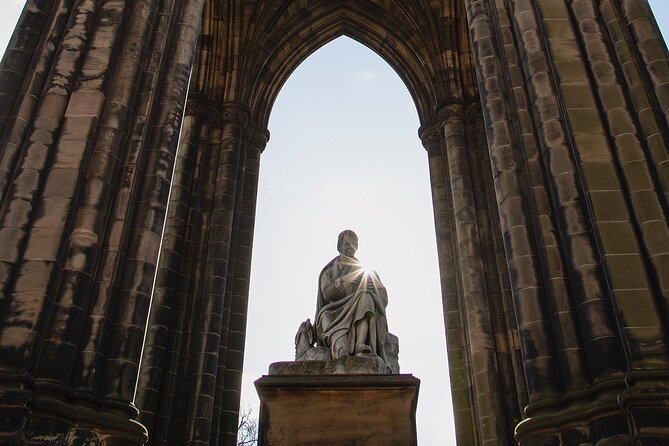
From Princes Street Gardens, the route continues to the Scott Monument. This dark, ornate landmark honors the writer Sir Walter Scott and is described as the largest monument in the world dedicated to a writer.
The stop lasts about 15 minutes. You will learn about the monument’s history and architecture, but you should not expect a climb or interior visit as part of this walking tour. The point is to understand why the monument occupies such an important place in Edinburgh’s public identity.
This stop also connects nicely with the tour’s wider literary theme. Arthur Conan Doyle is among the writers linked to the streets you explore, and Edinburgh’s reputation as an intellectual center is not limited to philosophers and scientists. The city’s public spaces celebrate writers as civic figures.
I find this part especially useful if you have already seen the castle and Royal Mile. The Old Town often gets the attention for medieval drama, while the Scott Monument shows how the later city honored literature in a different, more monumental way.
George Street, statues, and the New Town grid
The walk returns to the New Town and follows the eastern section of George Street. This is one of the principal streets in the planned district, lined with cafes, restaurants, shops, and statues.
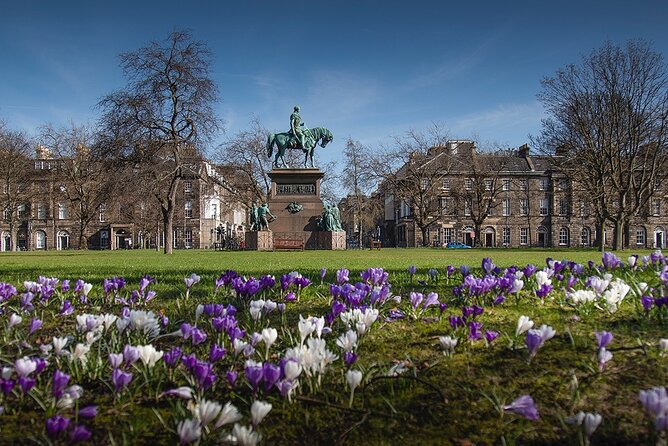
The route includes statues dedicated to King George IV and James Clerk Maxwell. These details make the street feel less like a long shopping avenue and more like a public record of the people Edinburgh chose to honor. The guide’s job here is to help you read those statues and buildings together.
The stop lasts roughly ten minutes. That keeps the tour moving, but it also means you will not receive a detailed explanation of every building on George Street. The route gives you a well-chosen introduction, then leaves you with enough orientation to return on your own.
If you have already visited the Old Town, this section is a strong reason to book. One of the most useful things a city tour can do is show you a new district in relation to the places you have already seen. The New Town is not just another collection of streets. It is a planned answer to the crowded medieval city nearby.
The Dome and the polished face of George Street
Near Rose Street, the walk reaches The Dome, one of the New Town’s best-known neoclassical buildings. George Street is known for restaurants, hotels, shops, and impressive facades, and The Dome gives you a clear example of the style.
The scheduled stop is short, about five minutes. Think of it as a pointed architectural pause rather than a full building visit. The guide identifies what makes the structure important, then the group continues.
You may want to return to this area after the tour because the walk does not include a meal or drink. The route shows you where the restaurants and cafes are, but you pay for anything you order separately. That arrangement keeps the tour focused and helps you decide later where to spend your own time and money.
Melville Monument and the colonial story
The route finishes in St. Andrews Square, where the Melville Monument occupies the center. The monument’s purpose and its connection to British colonial history are part of the discussion.
This is an important inclusion. Edinburgh’s grand squares and monuments can look detached from the forces that paid for them or shaped the people being honored. By discussing colonialism, the guide gives you a way to consider the New Town with both admiration and care.
The stop takes about ten minutes. You will not get every detail of Britain’s colonial past in that time, but you will encounter the subject as part of Edinburgh’s urban story. That makes the tour more useful than one that treats architecture as decoration alone.
Across the square is Dundas House, the final stop. Its design was inspired by the books of the Italian Renaissance architect Andrea Palladio. The building is now a bank, and the guide may enter if it is open. That qualification matters: the interior is not guaranteed, so expect the exterior explanation first.
Timing, group size, and value at $27.37
The tour lasts about two hours and fifteen minutes and visits 11 named stops. Most pauses last between five and fifteen minutes, with the longest scheduled visit in Dean Village at 30 minutes. This is a fairly full walking route, not a slow coffee-and-photographs stroll.
The group maximum is 20 people. That is large enough to give the tour energy, but small enough that you have a better chance of hearing the guide and asking questions. Guide Irene is specifically associated with positive experiences on this route, though the guide may vary by date.
At $27.37 per person, I see good value if you want interpretation, local orientation, and a clear route through areas you might not connect on your own. The tour includes no admissions, food, or transport, so you are paying for the guide’s time and the structure of the walk. That is fair for a city tour covering Dean Village, the New Town, Princes Street Gardens, and St. Andrews Square.
You can also use the tour to plan the rest of your visit. It ends outside Dundas House in St. Andrews Square, near the eastern end of the New Town. From there, you can continue exploring, find a restaurant, or make your way toward other central sights.
Who should book this Edinburgh walk
I would choose this tour if you have already seen, or plan to see, the Royal Mile and Edinburgh Castle and want a different side of the city. It is also a good first walk for anyone drawn to architecture, writers, public monuments, and the Scottish Enlightenment.
You should be comfortable walking outdoors for more than two hours. Most visitors can participate, service animals are allowed, and the route is near public transport. Still, the experience is not designed as an indoor or seated tour, and bad weather can change the plan.
The tour suits you best if you like stories attached to streets. You will hear about bakers and mill workers in Dean Village, wealthy residents in the Georgian New Town, secret bars, famous thinkers, writers, public statues, and the colonial forces behind civic wealth.
I would choose something else if you want extended time inside historic houses, a food tasting, or a very slow photographic walk. You may also prefer a private guide if you want the itinerary adjusted to your interests. For a compact introduction to central Edinburgh beyond the Old Town, though, this route covers a lot without requiring a full day.
Should you book it?
Book this walk if you want to connect Dean Village’s medieval working past with the New Town’s Georgian order, architecture, and intellectual life. The strongest parts are the sharp change of scenery, the castle views, the explanation of Georgian society, and the willingness to address colonialism instead of showing only polished facades.
The main tradeoff is that several stops are short and mostly outdoors. At $27.37, the walk offers solid value for a guided introduction, especially early in your visit when you want to get your bearings. If you are visiting in uncertain weather, keep your schedule flexible and remember that cancellation is free up to 24 hours before the start time.
FAQ
How long does the Dean Village and New Town walking tour last?
The tour lasts approximately 2 hours and 15 minutes.
How much does the tour cost?
The listed price is $27.37 per person.
Where does the tour begin?
The meeting point is 2 to 4 Hope Street, Edinburgh EH2 4DB, UK.
Where does the tour end?
The tour ends outside Dundas House in St. Andrews Square, Edinburgh EH2 2YB.
What places are included on the walking route?
The route includes Dean Village, Charlotte Square, the Georgian House exterior, Rose Street, Castle Street, Princes Street Gardens, the Scott Monument, George Street, The Dome, the Melville Monument, and Dundas House.
Is entry to the attractions included?
The tour includes a local guide, and the listed stops have free admission. The Georgian House is visited from the outside, and entry into Dundas House is possible only if the building is open.
How many people can join the tour?
The maximum group size is 20 people.
Can I cancel for a full refund?
Yes. You can cancel up to 24 hours before the experience start time for a full refund. Changes or cancellations made less than 24 hours before the start time are not accepted for a refund.
Just added around Edinburgh
- Private South Queensferry Town Walking Tour★ 5.0 · 3 reviews
- Blackness Castle Cruise★ 4.5 · 39 reviews
- Half Day Sailing Trip★ 5.0 · 11 reviews
- Edinburgh Shore Excursion: City Tour and Royal Yacht Britannia★ 4.0 · 41 reviews
- Edinburgh Shore Excursion with a Local Guide: 100% Personalized & Private★ 4.0 · 7 reviews
- Full Day Sailing Trip★ 5.0 · 10 reviews
- Whisky Tasting at Edinburgh’s Award Winning Whiski Rooms★ 5.0 · 5 reviews
- West Coast Lochs & Castles Tour – from Edinburgh★ 5.0 · 21 reviews
Walking Tours, compared.
Underground Vaults Walking Tour in Edinburgh Old Town
Read our review →
Edinburgh Castle: Guided Walking Tour with Entry Ticket
Read our review →
Edinburgh Castle Guided Walking Tour in English
Read our review →
Edinburgh Darkside Walking Tour: Mysteries, Murder and Legends
Read our review →

Old Town Walking Tour History and Tales in Edinburgh
Read our review →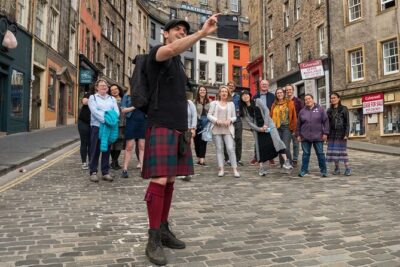

Browse the lists this tour appears in